The fog came in from the Firth of Forth just after nine, the way it did on most October nights, and by the time the tour group gathered at the iron gates of Kirkhaven Cemetery it had swallowed the street lamps whole. Daniel stood at the back with his camera bag on his shoulder and his collar turned up, feeling slightly ridiculous among the couples on holiday and the students who had come for a scare.
He had not come for a scare. He had come for the angels.
For two years he had been photographing funerary sculpture across Scotland for a book his publisher kept calling "a niche project" in a tone that meant it would never make money. Kirkhaven had the finest Victorian angels in Edinburgh, and the only way inside after dark, when the light was soft and the stone looked almost alive, was the midnight tour.
The guide arrived at exactly half past nine, carrying an old brass lantern.
She was tall, made taller by black boots with a modest heel, and wrapped in a long coat of dark green velvet that brushed the cobbles. Her hair was black and straight, cut in a heavy fringe above eyes lined so precisely they looked drawn with a pen. Her lips were the colour of red wine. At her throat she wore a silver pendant in the shape of a moth.
"Good evening," she said. "My name is Isolde, and I'll be your guide among the dead tonight. Stay close to the lantern. The dead don't mind visitors. The paths are another matter."
A few people laughed nervously. Daniel did not laugh. He was looking at the way the lantern light caught the edges of her face and thinking, absurdly, that she was the best-lit thing he had seen in two years.

The angel with folded wings
Isolde told stories well. She spoke about body snatchers and iron cages over graves, about a poet who had asked to be buried with his violin, about a merchant's daughter who was said to walk the eastern wall on nights like this. She never raised her voice and she never tried to frighten anyone. Somehow that made it more effective.
Daniel lagged behind, as he always did, setting up his small tripod in front of each sculpture. When the group moved on toward the old vaults, he stayed in front of an angel he had wanted to photograph for months: a life-size figure with folded wings, head bowed, one hand resting on a broken column. The fog wrapped around her like a veil.
"You're going to lose the group."
He turned. Isolde was standing a few paths away with the lantern held low, watching him with an expression he could not read.
"Sorry," he said. "I'm working. Sort of. I'm photographing the angels."
"All of them?"
"All the good ones in Scotland. She's the best."
Isolde came closer and looked at the angel for a long moment. "She is," she said quietly. "Most people walk straight past her. They want the vaults and the ghosts." She glanced at his camera, then at him. "Your exposure is going to be too long. The fog is moving. Here."
She lifted the lantern and held it out to the side, at shoulder height, so that its warm light fell across the angel's bowed face and folded wings, sculpting every feather. Daniel looked through the viewfinder and forgot to breathe.
"Take it," she said. "I can't stand here all night. I have eleven tourists and a ghost to look after."
He took it. Then he took four more. When he looked up she was already walking away, the lantern swinging, the hem of her velvet coat disappearing into the fog.
The church that is no longer a church
He found her again because of a poster.
It was pinned to a noticeboard in a café on the Grassmarket, black with silver lettering: NOCTURNE. Organ music for the night-minded. Every Friday, St Columba's. Underneath, in smaller letters: at the organ: Isolde Black.
St Columba's had stopped being a church twenty years earlier. Now it was a venue, with a bar where the font had been and candles in every window, but the great pipe organ was still there, and on Friday nights it filled the building with sound. Daniel arrived late, slipped into a pew near the back and stayed there for an hour without moving.
She played Bach first, then something he did not recognise, slow and dark and huge, the low notes shaking the old wooden pews. She sat with her back to the audience, her hair pinned up, her shoulders bare above a black dress that shone when she moved. The candlelight caught it every time she reached for the stops, and it took him a long time to understand that the dress was not silk.
It was latex. Black, polished, fitted like it had been poured onto her.
When the last chord faded and the small crowd applauded, she turned on the bench, scanned the pews, and her eyes stopped on him. She did not look surprised.
"The angel photographer," she said when he reached the front. "Did she come out well?"
"Better than well." He held out his phone and showed her the photograph: the bowed head, the wings, the lantern light. She studied it for a long moment.
"That's my light," she said at last.
"It's your light. I thought you should have a print."
"You came all the way here to give me a print?"
"I came to hear you play," he said. "The print was an excuse."
Isolde looked at him the way she had looked at the angel: long and careful, as though deciding whether he was worth stopping for. Then she smiled for the first time, a slow smile that changed her whole face.
"Buy me a drink at the font," she said. "And then you can tell me why a man spends two years photographing grief."

Velvet and rubber
They talked until the bar closed. He told her about the book, about his grandmother's grave in a village in Fife and the angel above it that had started everything. She told him she had been a goth since she was thirteen and had found The Cure on a cassette in her uncle's car, that she had studied the organ in Leipzig, that she gave cemetery tours because she loved the stories and because organists earned almost nothing.
"And the dress?" he asked, when the second glass of wine had made him brave.
She ran a finger down the shining black of her own sleeve and it made a faint, soft sound.
"I wear it when I play," she said. "It holds me. It's like being in armour that also feels like skin. Under the velvet coat, nobody on the tours knows." She tilted her head. "Does it bother you?"
"No," he said, and his voice came out rougher than he intended. "No, it doesn't bother me at all."
Isolde laughed, low and pleased. "I noticed. You've been trying very hard not to look at it for two hours."
"I've been failing."
"I know." She finished her wine and stood, gathering the velvet coat from the pew. "I live ten minutes away. It's raining. You can walk me home, and you can look as much as you like on the way, because I've decided I don't mind."
The flat on Ramsay Lane
Her flat was at the top of a narrow stone stair, four floors up, with windows that looked over the black roofs of the Old Town to the castle. It was exactly as he had imagined and also completely different: dark red walls, books stacked everywhere, an old upright piano, dried roses hanging upside down from a beam, and candles, dozens of them, which she lit one by one with long matches while he stood in the doorway dripping rain.
"Take your coat off," she said without turning. "You're making a puddle on my floor."
He did. When she turned around, she had taken off the velvet coat too, and she stood in the middle of the candlelit room in the black latex dress, polished to a mirror, every curve of her drawn in light. She watched him look at her. She let him look for a long time.
"Come here," she said.
He crossed the room. She did not kiss him at once. She took his hands, both of them, and placed them on her waist, and he felt the warmth of her body through the thin, smooth rubber, the way it moved with every breath she took.
"Slowly," she said. "Latex doesn't like to be rushed. Neither do I."
His hands moved up along her sides, over the curve of her ribs, and the dress made that faint sound again under his palms, and she closed her eyes and leaned into him. When she finally kissed him, it was the same way she played: slow, deliberate, building until he felt it in his whole body.
"There are rules," she whispered against his mouth.
"Tell me."
"You don't pull at the dress. It tears. You let me take it off when I'm ready." She bit his lower lip gently. "And you tell me if anything is too much. Anything. I'll stop."
"Same for you."
She smiled. "Good. Then we understand each other."

Nocturne
She undressed him first, slowly, button by button, kissing each new piece of skin she uncovered, until he stood in front of her with nothing on while she was still sealed in shining black. There was something about that imbalance that made his heart pound. She knew it. She walked a slow circle around him, trailing her fingertips across his shoulders, his back, his chest.
"Sit," she said, nodding at the edge of the bed, and he sat.
She stepped between his knees and took his hands again and showed him how to touch her through the latex: flat palms, slow strokes, the gentle pressure that made the rubber warm and glide. He traced the shape of her breasts through the dress and she breathed in sharply. He followed the line of her hip down to where the hem stopped at her thighs, and she shivered.
"Now," she said, "help me out of it. Slowly. Roll it, don't pull."
The zip ran the length of her back. He drew it down and the dress loosened, and she guided his hands to peel it down from her shoulders, along her arms, over her breasts, the rubber reluctant and clinging, releasing her inch by inch. Her skin underneath was warm and flushed and glowing with the silicone she had used to dress. He kissed every part of her he uncovered, the way she had kissed him, and by the time the dress lay in a black pool on the floorboards she was trembling.
She pushed him back onto the bed and climbed over him, kneeling astride his hips, her hair coming loose from its pins and falling in black lines across her shoulders. In the candlelight she looked like one of her own stories: something from the old town, something beautiful and slightly dangerous that you met in the fog and could not forget.
"Look at me," she said, and took him inside her, slowly, her eyes never leaving his.
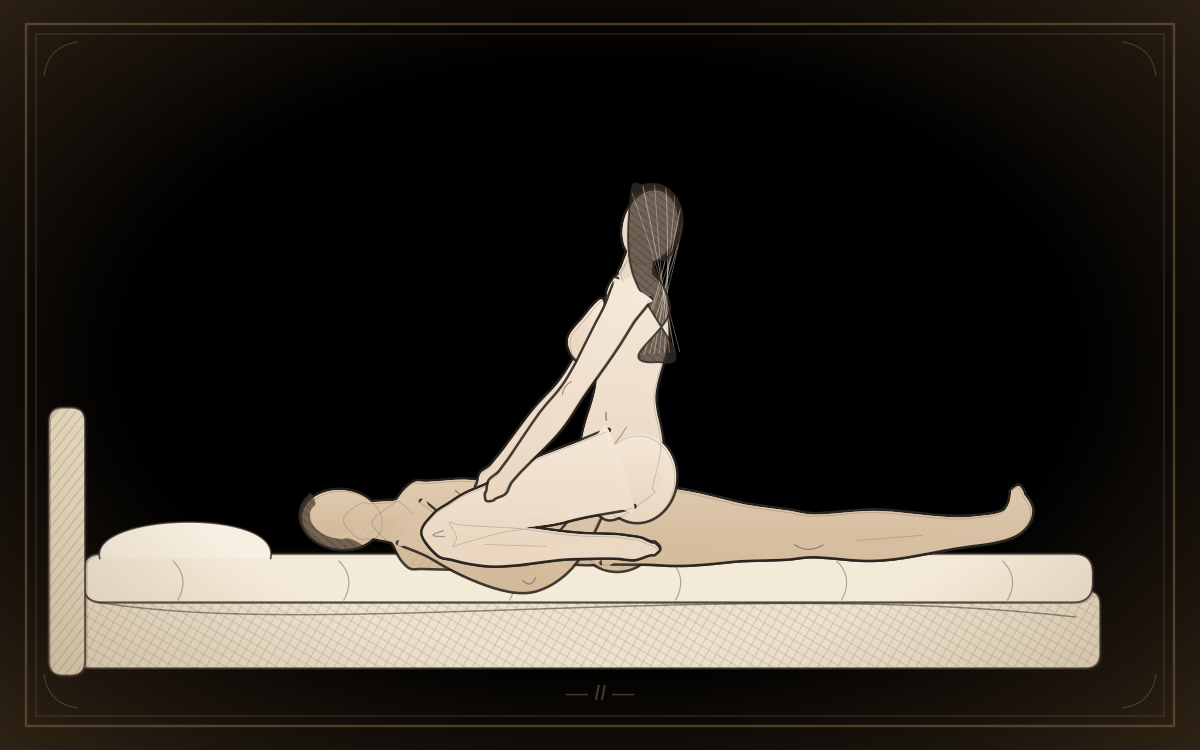
She set the rhythm the way she had set the tempo on the organ: slow at first, almost unbearably slow, then building, then holding back again just when he thought he could not take any more. When he reached for her hips she caught his wrists and pressed them to the pillow above his head, and smiled down at him, and he understood that she was conducting and he was the instrument and that he did not want it any other way.
The rain hammered on the windows. The candles flickered every time a gust came through the old frames. Somewhere below, a late bus rumbled up the Royal Mile. None of it seemed real except her: the weight of her, the heat, the soft sounds she made and then the less soft ones, her nails pressing into his wrists.
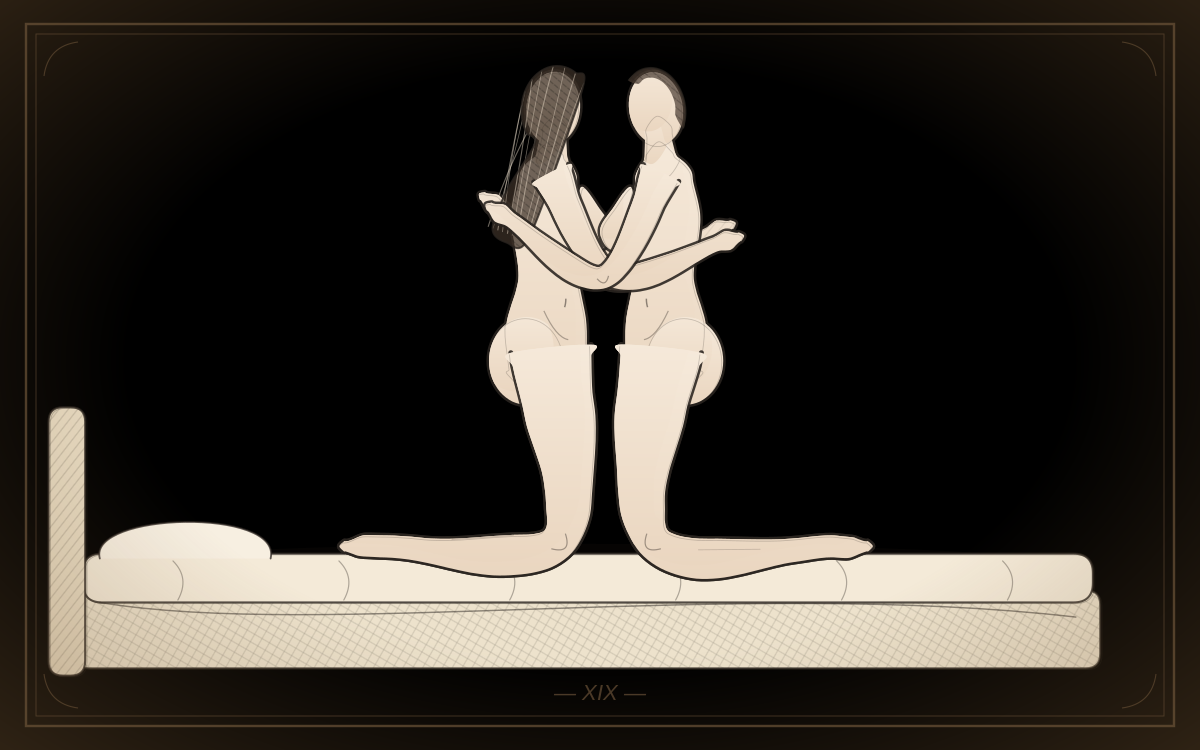
When she came, she threw her head back and said his name in a voice he had not heard from her before, raw and surprised, and the sound of it nearly undid him. She did not let him go. She leaned down, released his wrists, and wrapped her arms around his neck, and they turned together until they were kneeling face to face in the middle of the bed, chest to chest, her legs around him, her forehead pressed against his.
"Now you," she whispered. "Slowly."
It was slow. It was the slowest, deepest thing he had ever felt, rocking together in the candlelight with her breath in his ear and her heartbeat against his chest, and when he finally came apart she held him through it, both arms tight around him, murmuring something in German he did not understand and did not need to.
Coda
Afterwards she wrapped them both in a heavy black quilt, and they lay listening to the rain while the candles burned down one by one. She got up once, naked and unhurried, to rinse the latex dress in the bath with a drop of soap and hang it carefully on a wide hanger, and he watched her from the bed with an ache of tenderness he had not expected.
"You look after it like a living thing," he said when she came back.
"It is a living thing. Rubber comes from a tree." She curled against him. "If you treat it badly, it dies. Like most things worth having."
He kissed her hair. Outside, the fog was coming back, softening the castle into a grey shape against the dark.
"The book," she said after a while. "The angels. Is there a cover yet?"
"No. The publisher wants something dramatic. I've been arguing with them for months."
Isolde lifted her head and looked at him, and the slow smile came back.
"Then use mine," she said. "The angel with the folded wings. My light." She paused. "And on Sunday night, after the tour, I'll show you the one in the eastern vault. Nobody sees her. You need special permission, and a guide who likes you very much."
"Do you like me very much?"
She settled back against his chest and pulled the quilt over them both.
"Come to the tour on Sunday," she said, "and find out."
This is fiction about two consenting adults. Latex needs care and patience: use a dressing aid, never pull it by the edges, and agree on limits before any play. Curious about the culture behind this story? Read our latex fetish guide and how to meet goth girls, or browse our goth creators guide and latex guide.